

Give You Free Regular Updates on AZ-305 Exam Questions Jan 09, 2024
Achieve the AZ-305 Exam Best Results with Help from Microsoft Certified Experts
Microsoft Azure is a cloud computing platform that is rapidly gaining popularity among businesses looking for cost-effective and scalable solutions for their IT needs. As more and more companies migrate their operations to the cloud, the demand for skilled Azure professionals is growing. To help professionals validate their Azure expertise, Microsoft has created a range of certification exams, including the AZ-305 (Designing Microsoft Azure Infrastructure Solutions) exam.
To pass the AZ-305 exam, candidates must demonstrate proficiency in various areas, including designing and implementing Azure compute, storage, and networking solutions, managing Azure resources, and designing Azure security and identity solutions. Candidates must also have a solid understanding of Azure governance, hybrid cloud scenarios, and Azure migration strategies.
NEW QUESTION # 10
Your company deploys several Linux and Windows virtual machines (VMs) to Azure. The VMs are deployed with the Microsoft Dependency Agent and the Log Analytics Agent installed by using Azure VM extensions. On-premises connectivity has been enabled by using Azure ExpressRoute.
You need to design a solution to monitor the VMs.
Which Azure monitoring services should you use? To answer, select the appropriate Azure monitoring services in the answer area.
NOTE: Each correct selection is worth one point.
Answer:
Explanation:
Reference:
https://docs.microsoft.com/en-us/azure/network-watcher/traffic-analytics
https://docs.microsoft.com/en-us/azure/azure-monitor/insights/service-map
NEW QUESTION # 11
You have an Azure subscription named Subscription1 that is linked to a hybrid Azure Active Directory (Azure AD) tenant.
You have an on-premises datacenter that doesNOThave a VPN connection to Subscription1. The datacenter contains a computer named Server1 that has Microsoft SQL Server 2016 installed. Server1 is prevented from accessing the internet.
An Azure logic app named LogicApp1 requires write access to a database on Server1.
You need to recommend a solution to provide LogicApp1 with the ability to access Server1.
What should you recommend deploying on-premises and in Azure? To answer, select the appropriate options in the answer area.
NOTE:Each correct selection is worth one point.
Answer:
Explanation:
Explanation
Graphical user interface, text, application, chat or text message Description automatically generated
Box 1: An on-premises data gateway
For logic apps in global, multi-tenant Azure that connect to on-premises SQL Server, you need to have the on-premises data gateway installed on a local computer and a data gateway resource that's already created in Azure.
Box 2: A connection gateway resource
Reference:
https://docs.microsoft.com/en-us/azure/connectors/connectors-create-api-sqlazure
NEW QUESTION # 12
You design a solution for the web tier of WebApp1 as shown in the exhibit.
For each of the following statements, select Yes if the statement is true. Otherwise, select No.
Answer:
Explanation:
Reference:
https://docs.microsoft.com/en-us/azure/traffic-manager/traffic-manager-overview
https://blogs.msdn.microsoft.com/hsirtl/2017/07/03/autoscaling-azure-web-apps/
Topic 2, Litware, Inc
General Overview
Litware, Inc. is a medium-sized finance company.
Overview
Physical Locations
Litware has a main office in Boston.
Existing Environment
Identity Environment
The network contains an Active Directory forest named Litware.com that is linked to an Azure Active Directory (Azure AD) tenant named Litware.com. All users have Azure Active Directory Premium P2 licenses.
Litware has a second Azure AD tenant named dev.Litware.com that is used as a development environment.
The Litware.com tenant has a conditional access policy named capolicy1. Capolicy1 requires that when users manage the Azure subscription for a production environment by using the Azure portal, they must connect from a hybrid Azure AD-joined device.
Existing Environment. Azure Environment
Litware has 10 Azure subscriptions that are linked to the Litware.com tenant and five Azure subscriptions that are linked to the dev.Litware.com tenant. All the subscriptions are in an Enterprise Agreement (EA).
The Litware.com tenant contains a custom Azure role-based access control (Azure RBAC) role named Role1 that grants the DataActions read permission to the blobs and files in Azure Storage.
Existing Environment. On-premises Environment
The on-premises network of Litware contains the resources shown in the following table.
Existing Environment. Network Environment
Litware has ExpressRoute connectivity to Azure.
Planned Changes and Requirements. Planned Changes
Litware plans to implement the following changes:
Migrate DB1 and DB2 to Azure.
Migrate App1 to Azure virtual machines.
Deploy the Azure virtual machines that will host App1 to Azure dedicated hosts.
Planned Changes and Requirements.
Authentication and Authorization Requirements
Litware identifies the following authentication and authorization requirements:
Users that manage the production environment by using the Azure portal must connect from a hybrid Azure AD-joined device and authenticate by using Azure Multi-Factor Authentication (MFA).
The Network Contributor built-in RBAC role must be used to grant permission to all the virtual networks in all the Azure subscriptions.
To access the resources in Azure, App1 must use the managed identity of the virtual machines that will host the app.
Role1 must be used to assign permissions to the storage accounts of all the Azure subscriptions.
RBAC roles must be applied at the highest level possible.
Planned Changes and Requirements. Resiliency Requirements
Litware identifies the following resiliency requirements:
Once migrated to Azure, DB1 and DB2 must meet the following requirements:
- Maintain availability if two availability zones in the local Azure region fail.
- Fail over automatically.
- Minimize I/O latency.
App1 must meet the following requirements:
- Be hosted in an Azure region that supports availability zones.
- Be hosted on Azure virtual machines that support automatic scaling.
- Maintain availability if two availability zones in the local Azure region fail.
Planned Changes and Requirements. Security and Compliance Requirements
Litware identifies the following security and compliance requirements:
Once App1 is migrated to Azure, you must ensure that new data can be written to the app, and the modification of new and existing data is prevented for a period of three years.
On-premises users and services must be able to access the Azure Storage account that will host the data in App1.
Access to the public endpoint of the Azure Storage account that will host the App1 data must be prevented.
All Azure SQL databases in the production environment must have Transparent Data Encryption (TDE) enabled.
App1 must not share physical hardware with other workloads.
Planned Changes and Requirements. Business Requirements
Litware identifies the following business requirements:
Minimize administrative effort.
Minimize costs.
NEW QUESTION # 13
You plan to import data from your on-premises environment to Azure. The data Is shown in the following table.
What should you recommend using to migrate the data? To answer, drag the appropriate tools to the correct data sources-Each tool may be used once, more than once, or not at all. You may need to drag the split bar between panes or scroll to view content.
NOTE: Each correct selection is worth one point.
Answer:
Explanation:
Explanation
References:
https://docs.microsoft.com/en-us/azure/dms/tutorial-sql-server-to-azure-sql
https://docs.microsoft.com/en-us/azure/cosmos-db/import-data
NEW QUESTION # 14
You need to design an architecture to capture the creation of users and the assignment of roles. The captured data must be stored in Azure Cosmos DB.
Which Azure services should you include in the design? To answer, drag the appropriate services to the correct targets. Each service may be used once, more than once, or not at all. You may need to drag the split bar between panes or scroll to view content.
NOTE: Each correct selection is worth one point.
Answer:
Explanation:
NEW QUESTION # 15
You are developing a multi-tier app named App1 that will be hosted on Azure virtual machines. The peak utilization periods for App1 will be from 8 AM to 9 AM and 4 PM to 5 PM on weekdays.
You need to deploy the infrastructure for App1. The solution must meet the following requirements:
* Support virtual machines deployed to four availability zones across two Azure regions.
* Minimize costs by accumulating CPU credits during periods of low utilization.
What is the minimum number of virtual networks you should deploy, and which virtual machine size should you use? To answer, select the appropriate options in the answer area.
NOTE: Each correct selection is worth one point.
Answer:
Explanation:
Explanation
NEW QUESTION # 16
You have an Azure subscription that contains the storage accounts shown in the following table.
You plan to implement two new apps that have the requirements shown in the following table.
Which storage accounts should you recommend using for each app? To answer, select the appropriate options in the answer area.
NOTE: Each correct selection is worth one point.
Answer:
Explanation:
NEW QUESTION # 17
You plan to deploy an Azure web app named Appl that will use Azure Active Directory (Azure AD) authentication.
App1 will be accessed from the internet by the users at your company. All the users have computers that run Windows 10 and are joined to Azure AD.
You need to recommend a solution to ensure that the users can connect to App1 without being prompted for authentication and can access App1 only from company-owned computers.
What should you recommend for each requirement? To answer, select the appropriate options in the answer area.
NOTE: Each correct selection is worth one point.
Answer:
Explanation:
Reference:
https://codingcanvas.com/using-azure-active-directory-authentication-in-your-web-application/
https://docs.microsoft.com/en-us/azure/active-directory/conditional-access/overview
https://docs.microsoft.com/en-us/powerapps/developer/data-platform/walkthrough-register-app-azure-active-directory#:~:text=Create%20an%20application%20registration%201%20Create%20an%20application,the%20options%20and%20click%20on%20Add%20permissions.%20
NEW QUESTION # 18
You have an on-premises Microsoft SQL Server database named SQL1.
You plan to migrate SQL 1 to Azure.
You need to recommend a hosting solution for SQL1. The solution must meet the following requirements:
* Support the deployment of multiple secondary, read-only replicas.
* Support automatic replication between primary and secondary replicas.
* Support failover between primary and secondary replicas within a 15-minute recovery time objective (RTO).
Answer:
Explanation:
NEW QUESTION # 19
Your on-premises network contains a server named Server1 that runs an ASP.NET application named App1.
You have a hybrid deployment of Azure Active Directory (Azure AD).
You need to recommend a solution to ensure that users sign in by using their Azure AD account and Azure Multi-Factor Authentication (MFA) when they connect to App1 from the internet.
Which three Azure services should you recommend be deployed and configured in sequence? To answer, move the appropriate services from the list of services to the answer area and arrange them in the correct order.
Answer:
Explanation: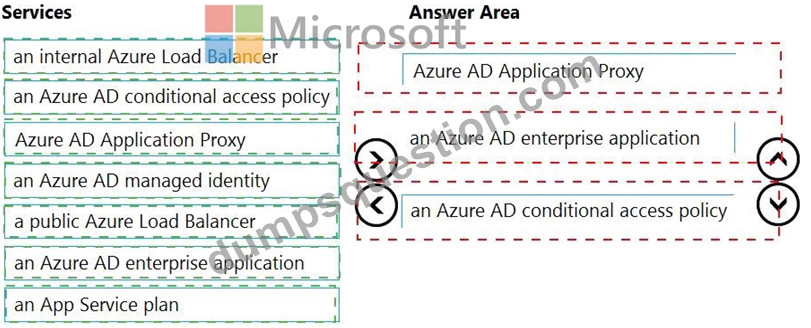
Explanation
AD Application Proxy
AD Enterprise Application
AD Conditional access policy
https://thesleepyadmins.com/2019/02/
NEW QUESTION # 20
Your company has 20 web APIs that were developed in-house.
The company is developing 10 web apps that will use the web APIs. The web apps and the APIs are registered in the company s Azure AD tenant. The web APIs are published by using Azure API Management.
You need to recommend a solution to block unauthorized requests originating from the web apps from reaching the web APIs. The solution must meet the following requirements:
* Use Azure AD-generated claims.
* Minimize configuration and management effort
What should you include in the recommendation? To answer, select the appropriate options in the answer area.
NOTE: Each correct selection is worth one point.
NOTE: Each correct selection is worth one point.
Answer:
Explanation:
Explanation
Graphical user interface, text Description automatically generated with medium confidence
NEW QUESTION # 21
You need to implement the Azure RBAC role assignment. The solution must meet the authentication and authorization requirements.
How many assignment should you configure for the Network Contributor role for Role1? To answer, select appropriate in the answer area.
NOTE: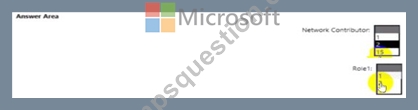
Answer:
Explanation:
NEW QUESTION # 22
What should you recommend to meet themonitoring requirements for App2?
- A. Microsoft Sentinel
- B. Azure Application Insights
- C. Container insights
- D. VM insights
Answer: B
NEW QUESTION # 23
You have an Azure subscription that is linked to an Azure Active Directory Premium Plan 2 tenant The tenant has multi-factor authentication (MFA) enabled for all users.
You have the named locations shown in the following table.
You have the users shown in the following table.
You plan to deploy the Conditional Access policies shown in the following table.
For each of the following statements, select Yes if the statement is true. Otherwise, select No.
NOTE: Each correct selection is worth one point.
Answer:
Explanation:
NEW QUESTION # 24
You need to ensure that users managing the production environment are registered for Azure MFA and must authenticate by using Azure MFA when they sign in to the Azure portal. The solution must meet the authentication and authorization requirements.
What should you do? To answer, select the appropriate options in the answer area.
NOTE: Each correct selection is worth one point.
Answer:
Explanation:
Reference:
https://docs.microsoft.com/en-us/azure/active-directory/identity-protection/howto-identity-protection-configure-mfa-policy
https://docs.microsoft.com/en-us/azure/active-directory/identity-protection/howto-identity-protection-configure-risk-policies
Topic 2, Fabrikam, Inc
Existing Environment
Fabrikam, Inc. is an engineering company that has offices throughout Europe. The company has a main office in London and three branch offices in Amsterdam Berlin, and Rome.
Active Directory Environment:
The network contains two Active Directory forests named corp.fabnkam.com and rd.fabrikam.com. There are no trust relationships between the forests. Corp.fabrikam.com is a production forest that contains identities used for internal user and computer authentication. Rd.fabrikam.com is used by the research and development (R&D) department only. The R&D department is restricted to using on-premises resources only.
Network Infrastructure:
Each office contains at least one domain controller from the corp.fabrikam.com domain. The main office contains all the domain controllers for the rd.fabrikam.com forest.
All the offices have a high-speed connection to the Internet.
An existing application named WebApp1 is hosted in the data center of the London office. WebApp1 is used by customers to place and track orders. WebApp1 has a web tier that uses Microsoft Internet Information Services (IIS) and a database tier that runs Microsoft SQL Server 2016. The web tier and the database tier are deployed to virtual machines that run on Hyper-V.
The IT department currently uses a separate Hyper-V environment to test updates to WebApp1.
Fabrikam purchases all Microsoft licenses through a Microsoft Enterprise Agreement that includes Software Assurance.
Problem Statement:
The use of Web App1 is unpredictable. At peak times, users often report delays. At other times, many resources for WebApp1 are underutilized.
Requirements:
Planned Changes:
Fabrikam plans to move most of its production workloads to Azure during the next few years.
As one of its first projects, the company plans to establish a hybrid identity model, facilitating an upcoming Microsoft Office 365 deployment All R&D operations will remain on-premises.
Fabrikam plans to migrate the production and test instances of WebApp1 to Azure.
Technical Requirements:
Fabrikam identifies the following technical requirements:
* Web site content must be easily updated from a single point.
* User input must be minimized when provisioning new app instances.
* Whenever possible, existing on premises licenses must be used to reduce cost.
* Users must always authenticate by using their corp.fabrikam.com UPN identity.
* Any new deployments to Azure must be redundant in case an Azure region fails.
* Whenever possible, solutions must be deployed to Azure by using platform as a service (PaaS).
* An email distribution group named IT Support must be notified of any issues relating to the directory synchronization services.
* Directory synchronization between Azure Active Directory (Azure AD) and corp.fabhkam.com must not be affected by a link failure between Azure and the on premises network.
Database Requirements:
Fabrikam identifies the following database requirements:
* Database metrics for the production instance of WebApp1 must be available for analysis so that database administrators can optimize the performance settings.
* To avoid disrupting customer access, database downtime must be minimized when databases are migrated.
* Database backups must be retained for a minimum of seven years to meet compliance requirement Security Requirements:
Fabrikam identifies the following security requirements:
*Company information including policies, templates, and data must be inaccessible to anyone outside the company
*Users on the on-premises network must be able to authenticate to corp.fabrikam.com if an Internet link fails.
*Administrators must be able authenticate to the Azure portal by using their corp.fabrikam.com credentials.
*All administrative access to the Azure portal must be secured by using multi-factor authentication.
*The testing of WebApp1 updates must not be visible to anyone outside the company.
NEW QUESTION # 25
You have an Azure subscription. The subscription contains Azure virtual machines that run Windows Server 2016 and Linux.
You need to use Azure Log Analytics design an alerting strategy for security-related events.
Which Log Analytics tables should you query? To answer, drag the appropriate tables to the correct log types. Each value may be used once, more than once, or not at all. You may need to drag the split bar between panes or scroll to view content.
NOTE: Each correct selection is worth one point.
Answer:
Explanation:
https://docs.microsoft.com/en-us/azure/azure-monitor/platform/log-analytics-agent Windows Event logs --> Information sent to the Windows event logging system. Syslog --> Information sent to the Linux event logging system.
NEW QUESTION # 26
You plan to migrate on-premises Microsoft SQL Server databases to Azure.
You need to recommend a deployment and resiliency solution that meets the following requirements:
Supports user-initiated backups
Supports multiple automatically replicated instances across Azure regions Minimizes administrative effort to implement and maintain business continuity What should you recommendation? To answer, select the appropriate options in the answer area.
NOTE: Each correct selection is worth one point.
Answer:
Explanation:
Reference:
https://docs.microsoft.com/en-us/azure/azure-sql/database/active-geo-replication-overview
NEW QUESTION # 27
You have an on-premises network that uses on IP address space of 172.16.0.0/16 You plan to deploy 25 virtual machines to a new azure subscription.
You identity the following technical requirements.
All Azure virtual machines must be placed on the same subnet subnet1.
All the Azure virtual machines must be able to communicate with all on premises severs.
The servers must be able to communicate between the on-premises network and Azure by using a site to site VPN.
You need to recommend a subnet design that meets the technical requirements.
What should you include in the recommendation? To answer, drag the appropriate network addresses to the correct subnet. Each network address may be used once, more than once or not at all. You may need to drag the split bar between panes or scroll to view content.
NOTE: Each correct selection is worth one point.
Answer:
Explanation:
NEW QUESTION # 28
You have the resources shown in the following table.
You create a new resource group in Azure named RG2.
You need to move the virtual machines to RG2.
What should you use to move each virtual machine? To answer, select the appropriate options in the answer area.
NOTE: Each correct selection is worth one point.
Answer:
Explanation:
NEW QUESTION # 29
You plan to migrate on-premises Microsoft SQL Server databases to Azure.
You need to recommend a deployment and resiliency solution that meets the following requirements:
Supports user-initiated backups
Supports multiple automatically replicated instances across Azure regions Minimizes administrative effort to implement and maintain business continuity What should you recommendation? To answer, select the appropriate options in the answer area.
NOTE: Each correct selection is worth one point.
Answer:
Explanation:
Reference:
https://docs.microsoft.com/en-us/azure/azure-sql/database/active-geo-replication-overview
NEW QUESTION # 30
You have an Azure subscription that contains the resources shown in the following table.
You create an Azure SQL database named DB1 that is hosted in the East US region.
To DB1, you add a diagnostic setting named Settings1. Settings1 archives SQLInsights to storage1 and sends SQLInsights to Workspace1.
For each of the following statements, select Yes if the statement is true. Otherwise, select No.
NOTE:Each correct selections is worth one point.
Answer:
Explanation:
Explanation
Box 1: Yes
Box 2: Yes
Box 3: Yes
For more information on Azure SQL diagnostics , you can visit the below linkhttps://docs.microsoft.com/en-us/azure/azure-sql/database/metrics-diagnostic-telemetry-logging-streaming-ex
NEW QUESTION # 31
You have the Azure resources shown in the following table.
You need to deploy a new Azure Firewall policy that will contain mandatory rules for all Azure Firewall deployments. The new policy will be configured as a parent policy for the existing policies.
What is the minimum number of additional Azure Firewall policies you should create?
- A. 0
- B. 1
- C. 2
- D. 3
Answer: D
Explanation:
Explanation
Firewall policies work across regions and subscriptions.
Place all your global configurations in the parent policy.
Note: Policies can be created in a hierarchy. You can create a parent/global policy that will contain configurations and rules that will apply to all/a number of firewall instances. Then you create a child policy that inherits from the parent; note that rules changes in the parent instantly appear in the child. The child is associated with a firewall and applies configurations/rules from the parent policy and the child policy instantly to the firewall.
Reference:
https://aidanfinn.com/?p=22006
NEW QUESTION # 32
You deploy several Azure SQL Database instances.
You plan to configure the Diagnostics settings on the databases as shown in the following exhibit.
Use the drop-down menus to select the answer choice that completes each statement based on the information presented in the graphic.
NOTE: Each correct selection is worth one point.
Answer:
Explanation:
Explanation
Graphical user interface, text, application Description automatically generated
In the exhibit, the SQLInsights data is configured to be stored in Azure Log Analytics for 90 days. However, the question is asking for the "maximum" amount of time that the data can be stored which is 730 days.
NEW QUESTION # 33
......
Microsoft AZ-305 Exam Syllabus Topics:
| Topic | Details |
|---|---|
| Topic 1 |
|
| Topic 2 |
|
| Topic 3 |
|
| Topic 4 |
|
| Topic 5 |
|
| Topic 6 |
|
Detailed New AZ-305 Exam Questions for Concept Clearance: https://actualtests.dumpsquestion.com/AZ-305-exam-dumps-collection.html